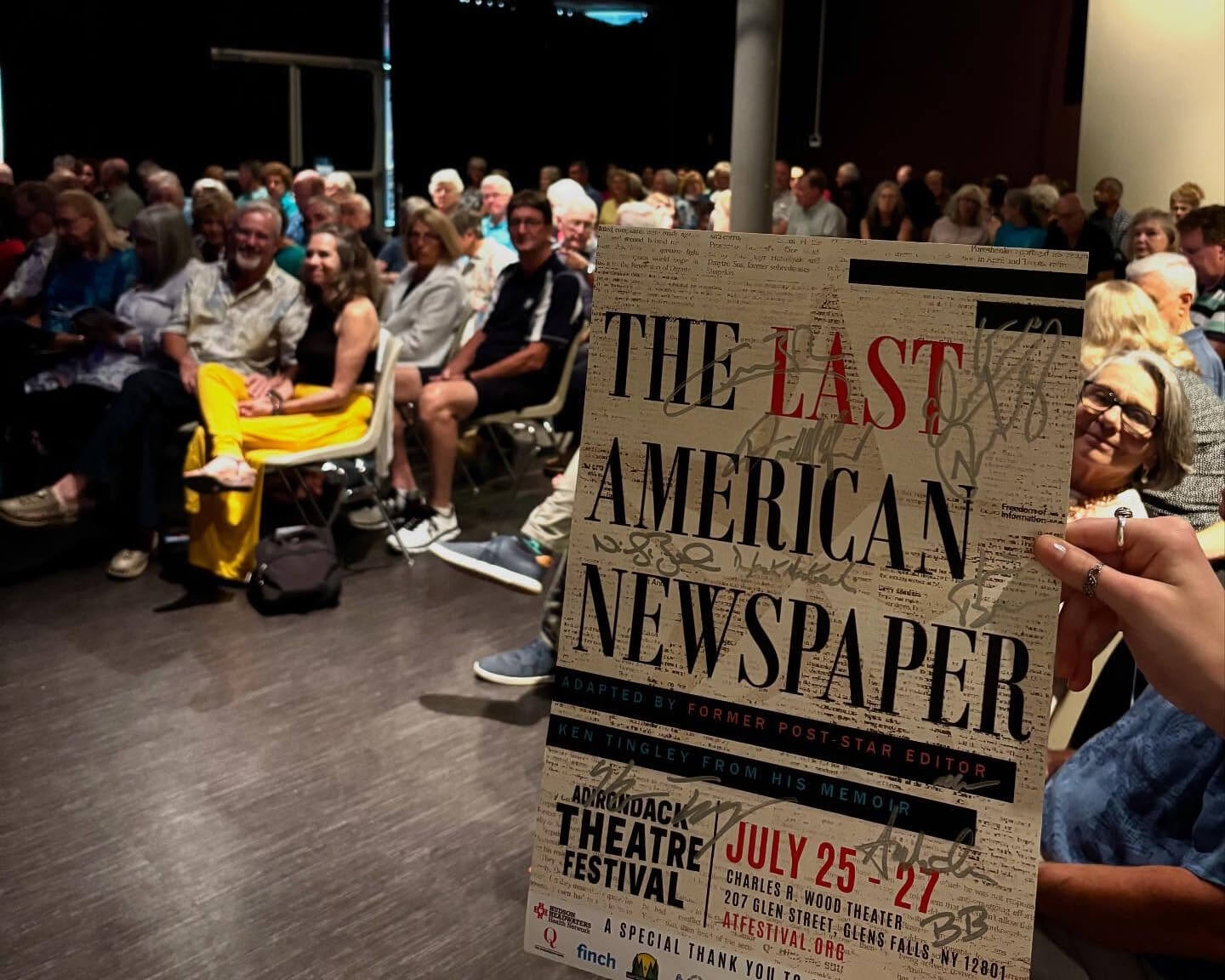
Over the weekend, the plea to save local news entered a new stage — the theatre.
In four sold-out staged readings at the Adirondack Theatre Festival from July 25-27, Ken Tingley presented “The Last American Newspaper,” a play adapted from his memoir about The Post-Star in Glens Falls, New York.
“I think it’s a great message, and I think a lot of people believe in newspapers, love their newspapers and miss their newspapers,” he said.
Tingley, 68, joined The Post-Star as the sports editor in 1989, after spending his early career at five different newspapers. He held that position for a decade until he became managing editor in 1999.
He remained editor of the Glens Falls newspaper for 21 years, during which it was named “Newspaper of Distinction” nine times by the New York State Associated Press Association and editorial page editor Mark Mahoney won the 2009 Pulitzer Prize for Editorial Writing.
“So we really set the bar high as far as our journalism,” Tingley said.
Tingley retired in 2020, at the beginning of the pandemic. He had witnessed his newsroom crumble from a peak of about 45 staffers to only 10. He calls his story one of “triumph and tragedy,” and he believes its title is symbolic of the decline of newspapers across the country.
“We built it all up, and then we had to watch it all being kind of torn down over the years,” he said.
Since 2002, the U.S. has lost about 75% of its local journalists, and over 3,200 print newspapers have disappeared since 2005, at a rate of more than two per week.
Under the ownership of Lee Enterprises, The Post-Star had to cut costs through frequent layoffs, reduced coverage and fewer print editions. The steady decline is not unique to this small-town paper — and that’s the point.
Right after he retired, Tingley wrote a column called “The Last American Editor,” and he started working on his memoir, “The Last American Newspaper.” The book has 28 chapters. He intended it to be a “love letter” to his colleagues at the paper, highlighting their best and boldest coverage during his tenure.

Actor Doug MacKechnie, producing artistic director Miriam Weisfeld and playwright Ken Tingley at rehearsal for “The Last American Newspaper.” (Courtesy: Adirondack Theatre Festival)
When he was promoting the book at the local Rotary Club and other venues, he was struck by the emotional reactions he saw in his audiences.
“There’s a dramatic story here about the work newspapers do,” he recalled thinking. He wanted to portray the passion, the sacrifices and the entire spirit of local journalism.
The Adirondack Theatre Festival runs from mid-June to mid-August, with three to six shows in a combination of full and developing productions. The 31-year-old festival works with professional actors and directors, primarily from New York City.
Tingley, a season ticket holder for most of his adult life, was concerned about diminishing crowds at the festival following the pandemic. He wondered if writing a play that was truly local to Glens Falls would bring back more fans.
He brought the play to producing artistic director Miriam Weisfeld. Weisfeld is also a dramaturg, meaning she works closely with writers to shape a story and think about its impact on the audience.
“When Ken proposed the idea, I was immediately intrigued because I knew that his books were really meaningful to a number of members of the community here, and that, in general, there’s something really meaningful about sort of reflecting a community story back to them,” she said.
“Of course, there’s the incredible urgency of sparking conversations all across the country about what’s going on in the journalism field and to free speech nationally. I mean, as an arts organization, that’s incredibly important to us as well,” she said.
Often, producers hire theatre professionals to write the stage adaptation for a film or book. But in this case, Weisfeld and director Marcus Kyd helped Tingley become a playwright.
Tingley had to condense 21 years into a two-hour running time and adapt every scene to take place in the newsroom. In revisions, Weisfeld helped him decide where to take artistic license and how to make the story more dramatic. The play is “inspired by the tradition of documentary theatre,” according to Weisfeld, so the true accounts and real events have been fictionalized.
“As a journalist, you have to go by the quote you have in your notebook. And somewhere about halfway through the process, I realized, ‘Hey, if I don’t like the quote, I can change it,’ ” Tingley said, laughing.
“I can make it better, as long as it’s saying the same thing, what it’s supposed to say,” he said. He still didn’t stray far from the facts, and he kept some quotes verbatim from the newsroom and newspaper articles.
The play has six main characters. Tingley, Mark Mahoney and Will Doolittle were real editors at The Post-Star and have the same roles in the production. The other three characters, two reporters and one city editor, are named and styled after a combination of many real-life staff members.

Actors Lisa Bruneau, Craig Wallace and Elizabeth Pietrangelo take a selfie onstage (Courtesy: Jim McLaughlin)
Act 1, Scene 1 opens to Tingley at the Rotary Club, speaking as The Post-Star’s new managing editor. The show then highlights some of the paper’s most memorable coverage, like a neighborhood evacuation for a tanker leak and a series on domestic violence. The tone starts to change as Act 2 scenes depict the financial struggles of a local newspaper in a modernizing world.
Each show this weekend was followed by a discussion with the audience, a common practice during the development process to gauge the production’s impact. The play first debuted in April at a developmental reading in Albany, and Weisfeld was surprised at how interested the audience was in the follow-up discussion about local journalism, despite a lack of familiarity with The Post-Star.
“It was great to learn that the show was really meaningful for people who didn’t know The Post-Star, who didn’t have a personal connection with many of those stories,” she said.
One audience question that stuck out to Tingley: How do we save newspapers, and how do we save journalism?
“That’s a tough one. I don’t know if I have a lot of great answers to that, you know. I tell people, ‘Support your newspaper, support your media outlets. Pay for it. Please start paying for it, because journalism is expensive to do,’ ” he said.
All four Glens Falls shows were sold out, with over 100 tickets in each. Attendees got to see reporters whose work they read in the paper and stories they lived through in their community, all brought to life again onstage.
“For an old newspaper guy to see the story of his newspaper on the stage was the thrill of a lifetime,” Tingley said over email on Monday. “But what was amazing to see was that the audience realized this was a story being experienced all over the country.”
Many editors and reporters that Tingley worked with at The Post-Star, including Will Doolittle, were also in the crowd. He said it was “really cool to share those moments with people who knew the stories and saw it all firsthand.”
After this weekend, depending on the success of fundraising campaigns and discussions with potential producing partners in New York City, Adirondack Theatre Festival aims to bring back “The Last American Newspaper” for a full production next year and expand to other locations.
“The purpose of a play is to reflect on a story collectively and publicly, and allow that story to challenge our thinking about the way that our society functions,” Weisfeld said.
“And so our hope, in commissioning and developing and hopefully ultimately producing this play, is that it can be a platform for that conversation, not only in a small town in upstate New York, but all over the country.”