Peter Alexander returned to television last week.
It seems odd to say “returned” because Alexander has spent most of the past 22 years on American TV screens, covering some of the country’s biggest news stories. In fact, over 22 years at NBC News, Alexander did just about everything a TV journalist could do.
He covered the White House, crisscrossed the country covering presidential campaigns, anchored war coverage, reported from the Olympics and filled in as a guest anchor on newscasts such as the “NBC Nightly News” and “Meet the Press.”
And he was the longtime co-host of the Saturday edition of the “Today” show.
But in March, after NBC News and MS NOW split, Alexander surprisingly left his television home of more than two decades to join MS NOW.
Last Tuesday, he made his official MS NOW debut, chipping in on the network’s election coverage. But, starting today, Alexander makes his big return.
Alexander’s new weekday program — “State of Play with Peter Alexander” — debuts at 11 a.m. Eastern time. Aside from his new show, Alexander also will be MS NOW’s chief national reporter and breaking news anchor.
Last Thursday, I spoke to Alexander via Zoom about leaving NBC, his new show and how to battle news fatigue.
Our conversation was edited for length and clarity.
Tom Jones: You just made your official debut on MS NOW’s election coverage after being off TV for a while. What have the past few months been like for you?
Peter Alexander: This is the longest hiatus I’ve had since I started doing television news 30 years ago, so I’ll acknowledge I had some butterflies before sitting down next to Rachel (Maddow) and Nicolle (Wallace) and Lawrence (O’Donnell) and Chris (Hayes).
I will say a couple things. One, if there are any reservations about what this would be like, those were all erased sitting there. My colleagues are so smart, and Rachel in particular is outstanding, but she’s also an incredible broadcaster, as a communicator of information. I was so impressed by her. It was fun to be back on the board, so to speak. I’m better at just doing the work than I am at talking about it. So it was nice to go out this week and talk to voters in Michigan and to kind of get back in the routine of things and find a place to continue doing what I enjoy.
Jones: Well, you didn’t seem rusty at all. You seemed like you were ready to go.
Alexander: I had a couple cobwebs to shake off. My mom said, “Oh, you were adorably nervous. A mom can put it in those terms.” I was like, “Oh, good.”
Jones: When you were at NBC, I know you talked about the schedule, and I think you said at one point you missed like 200-some Friday nights at home because you were getting ready for the weekend “Today” show. Still, how tough was it to make that decision to leave NBC? And what was it that made you excited to go to MS NOW?
Alexander: Well, first I’ll say there is an energy at MS NOW right now that I think is unmatched in a business, where we’re seeing a lot of contracting. MS NOW is growing and building. But, in 22 years at NBC and in 30 years of doing this professionally, I’ve never had something of my own. So (I liked) the idea of being able to produce a show … and focus on topics that I think matter, and draw them out into a wider conversation.
The thing that became a little bit stifling on network television was on the “Today” show — and let me be clear, those are some of my closest friends to this day — but I got like a minute and 45 (seconds) to be on television or nightly news. You have some cross-talk as they call it. You got a sound bite, or a Democrat bite and a Republican voter bite. … I’ve been at the White House for 14 years, covered four presidents, all sorts of campaigns, impeachments, Supreme Court nominations, confirmation fights. I’d done a lot of those things, and I think it doesn’t mean I stop doing those things, but I (now) get to do it and I get an hour, which I think will just sort of let me expand. I view both as a responsibility, but I sincerely view it as an opportunity, too. Like what a privilege to get to do that.
As it relates to NBC, this was an incredibly hard decision. All of my professional mentors, almost all of my professional mentors, are those I met within NBC from Tom Brokaw when I started, Andrea Mitchell, my closest friends Kelly O’Donnell, Kristen Welker. … I love this group, and the luxury is that I’m one floor above them in the building, so I get to see them a lot, and they are excited for me to be in a place where I get to showcase the things that we in private talk about all the time.
Jones: Consuming news these days is like trying to drink out of a fire hose. What might be the lead story of the day at 9 a.m. could end up being the fifth story on “Nightly News” …
Alexander: Or not making the “Nightly News” at all.
Jones: Right. So your show comes on at 11 a.m. Do you have any sense of how it will be put together when news is constantly changing?
Alexander: I’ll be candid. I think I’m going to learn as I go. I’m fortunately surrounded by a lot of good people. … I have folks that I call each day and pick their brain and get their sense of things, and so I think it’s sort of going to evolve.
One of the things that’s nice about 11 a.m. is that it’s as news is happening, right? I have years of experience covering breaking news, whether it’s from Afghanistan or Israel or Iraq, Beijing, all over the place. So I’m very comfortable in a breaking news situation. Also domestic, when there are either natural disasters or tragedies that happen, the Artemis launch, things that Americans are watching together. There’s a chance to anchor those moments that happen in the day. The morning shows sort of set the table. The evening shows often wrap it up. I get to be in it based on my experiences and my reporting as a reporter from the desk to help guide viewers through it as it is happening.
Jones: Describe to me what you want viewers to get out of this program.
Alexander: I want to produce a show that is respectful, curious, informative. I want to have a show that is focused less on panels and talking, and not opining about the news. (It’s about) talking to those who are making the news. I want to have a lot of lawmakers and principals and others. I hope this show, frankly, is a lot like the one that one of my mentors, Andrea Mitchell, used to do. I knew when I watched her show that I was going to leave having learned something, being better informed, and having heard from the people who are at the center of a lot of these decisions.
I think the thing that I feel most proud of is that I’ve built a relationship with viewers and the people that I cover. I think this is a time where people want to see good journalism succeed, and I hope to be a part not of the cacophony and all the noise, but I hope to be a part of the solution, of providing people with good information. I’m not an advocate for Republicans or Democrats. I’m an advocate for the facts.
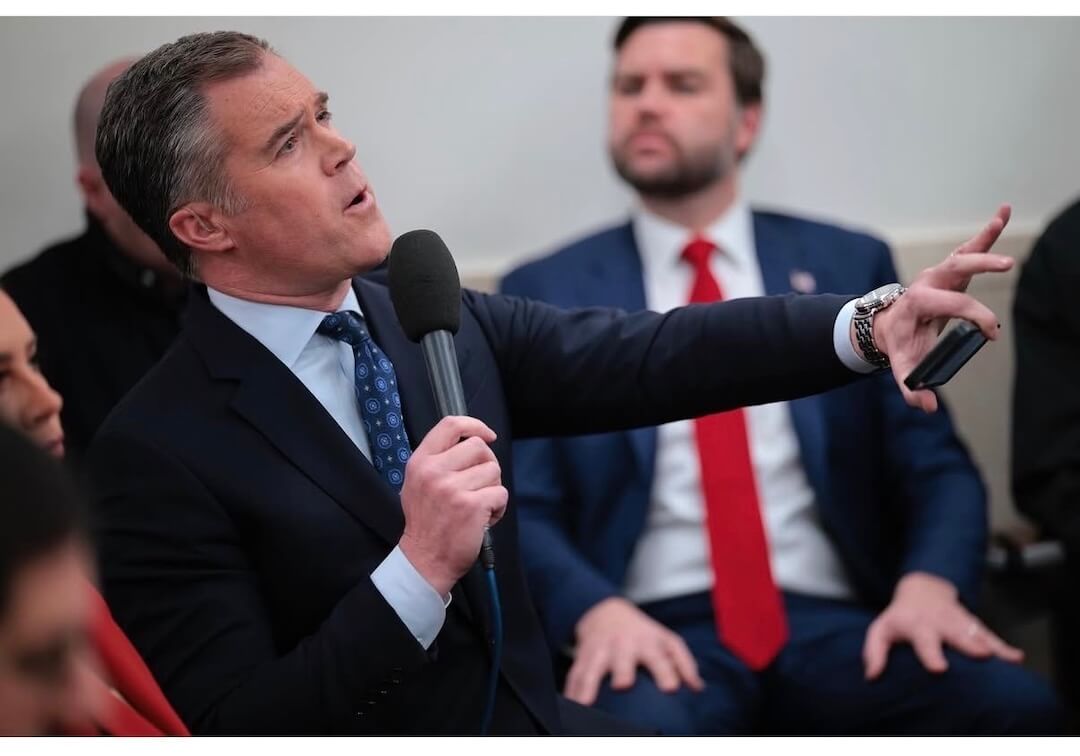
Peter Alexander, reporting here from the White House (Courtesy of MS NOW)
Jones: We’re in a time in this country where people tend to gravitate toward the news that they want to hear. A lot of people are tuning in and thinking, “I want you to give me the news I want to hear. I want you to confirm what I already think.” How do you handle that attitude?
Alexander: What I plan, what I promise to do, and what the bosses have asked me to do is to keep doing what I know how to do — which is to report, focusing on the facts and trying to get to the truth as often as I can. I think any audience, including the audience at MS NOW, is best served by good information, not just information that sort of validates your view. I think you just provide the facts and let the audience make its decision for itself, and I think a lot of times those facts will lead them to the conclusions they may already be making. But I’d rather lean into the facts.
Jones: I hear from viewers all the time who are frustrated by guests on news shows who come on and do not act in good faith. They lie, they pivot, they provide misinformation. What are your views on that?
Alexander: It’s one of the most challenging things we face right now, right? It’s like, do you amplify that? I covered Obama, then Trump, then Biden, then Trump. In the first term, Trump, obviously, we played unedited hours and hours of Trump speaking either on the stump, and then in a cabinet meeting, and then in my past life as NBC News, (a program) would come to me at the end of a two and a half hour set of (Trump) remarks and say, “What were your takeaways?” And I was like, “My takeaways? Like where do we begin?”
So I don’t think that serves the audience. We’re not going to take the president for two and a half hours when he’s speaking. I think you do need to hear what he’s saying, but you also need to do it in a forum. And I take pride in trying to do this, where you give it context. Take a look at what the president has said as it relates to Iran. Back in May — I don’t have the language in front of me — but back in May, the story was it would be done within weeks. In May, he threatened a big, big attack, and then he backed away, saying that they were opposed to a deal. He said the same thing just a couple of days ago, right? The president is, in a lot of ways, a day trader. He has to address today’s news cycle. But you put it in the big context of things. I think that helps the audience be better informed.
But to get back to the original question, do I want to have Stephen Miller on and get into a shouting match? I don’t think that serves anybody, really. I think what serves people is doing the work each day, asking the tough questions as often as possible, inviting good faith actors, and not amplifying misinformation.
Jones: Tell me about the name “State of Play.” Where did that come from?
Alexander: I’ll reveal to you one of my first ideas for a name. I had a lot of time to think about this. One of the first ideas I had was “Press Pass with Peter Alexander.” I like that one. It is alliterative, and I thought it helped identify to the audience that I’m a guy who is in the room and has been in all these places. But we’re not really called the press anymore, you know what I mean? …
I’m excited about the name “State of Play.” I think the idea of “play” means this thing is active; it’s moving because things are always churning as it relates to politics and it relates to what’s going on, not just in Washington but around the country. And when the show debuts, I think you’ll see that we really lean into my experiences reporting, and we bring on guests whose experiences reporting can add value to what we’re doing. And we also do some reporting as we’re going — during that show. Breaking news isn’t just you getting a scoop somewhere. It’s having a conversation with a newsmaker and pushing them on topics where they sometimes say something that sort of redirects the conversation in Washington and around the country. So I’m excited to be a part of the “state of play” as the news is developing over the course of a day.
Jones: News fatigue is a real thing, not just for audiences, but for journalists. Were you able to recharge during your time away?
Alexander: Doing this for a living is exhilarating and exhausting. Covering the White House for most of the last 14 years, it is nonstop. During my time at NBC, I was getting up before six in the morning, and often writing till 11 or midnight. Those are long days.
So, yeah, I embrace this opportunity because I think it means I get to see my kids (daughters, ages 13 and 11) a little bit more often in the afternoon. I’ll miss them in the morning. I can FaceTime breakfast, but maybe pick them up, and I won’t miss dance performances, and I’m not going to miss as many school plays and soccer games.
I just turned 50, so this is like a good time in life for me to pursue something new. I’ve hit a little threshold as an adult and professionally, you know, opening up a new tab, as it were. We took the girls to a dude ranch, and I did a lot more horseback riding than my bottom was prepared for. But I really view now more than ever that time is finite. I sacrificed a lot for amazing experiences working at NBC. All of them I’m grateful for, but I do want to try to find a little better balance.
Jones: So, this new show — are you excited, nervous? How are you feeling?
Alexander: I’m raring to go. I’m excited. I’m glad I broke the seal, having been on the air with the team already. They have been so welcoming. I’ve been so impressed by the people here. I think I was nervous to leave the people that I knew, the team that I was used to surrounding myself with, and picking the brains of, and peppering each other back and forth with proposed questions and what the likely response would be. But I feel like I’ve picked up right where I left off, and I’ve been so impressed by how many incredible journalists there are here. I’m excited.
Here’s the thing: I think we’re all rooting for journalism to do well, to succeed right now. At the end of the day, yeah. I’m not going to make any big proclamations about what I will or will not accomplish. I just want to be a part of the solution. I want journalism to keep succeeding. I want to be on the side of the good guys, which is working to help give good information each day.
My thanks to Peter Alexander. His show “State of Play with Peter Alexander” debuts today at 11 a.m. on MS NOW and will air weekdays in that time slot. Now onto the rest of today’s newsletter …
Out of Times
Conservative columnist Ross Douthat has written his final column for The New York Times. After 17 years there, Douthat is leaving to join “60 Minutes” as a correspondent.
His final column — “Who Are the Good Guys and the Bad Guys? I’m No Longer Sure.” — took aim at both conservatives and liberals, and was highly critical, at times, of the Trump administration.
Douthat wrote that “Donald Trump’s second term populism has displayed most of the vices that its critics anticipated. It has been corrupt and bullying and destabilizing. It has rewarded hacks and cronies. And it stumbled into a Middle Eastern war with even less preparation than its establishment predecessors.”
He had plenty more to say about the state of American politics in his farewell column.
Douthat also used the column to say goodbye while addressing his goals for “60 Minutes,” writing, “I’ll express — along with incalculable gratitude to The Times itself, my colleagues and editors — a hope that I have contributed illumination. I hope my writing has added something to your understanding of America’s complexity, the world’s uncertain future and the strangeness of our times. I hope that I make that kind of contribution at ‘60 Minutes.’ I hope The Times can continue to illuminate the world as only a great newspaper can. And wherever I’m working and whatever you’re reading, we’ll all be going into the future together — and trusting, like many Americans before us, that there’s an angel giving directions somewhere in the storm.”
High praise
Here’s a thoughtful opinion piece in The Washington Post from Will Leitch: “In an age of madness, ‘Last Week Tonight’ makes me feel sane.”
This passage from Leitch was especially good: “I have never met John Oliver. We are not actually friends. He is not making his show specifically for me. But it feels that way, and if you’re a fan, I bet it does to you, too. In a time when many have never felt more powerless, there is strength in being the wisenheimer in the back of the room, tossing spit wads … and always, always telling the truth. I’d be lost without that. We all would.”
Media tidbits
- The New York Times’ Matt Flegenheimer with “Anthony Scaramucci’s Special Relationship.”
- Also from The New York Times, it’s Jeremy W. Peters with “A Democratic Socialist Seeks New Voters in an Unlikely Place: Fox News.”
- For The Atlantic, Peter Wehner with “Why MAGA Is So Obsessed With Fauci.”
- Mediaite’s Joe DePaolo with “‘That is Misinformation!’ CBS’s Brennan Battles Trump’s CDC Chief in Fiery Brawl on Vaccines and Trust in Public Health.”
- Reuters’ Jasper Ward with “Taylor Swift songs removed from White House, Trump campaign posts.”
- Front Office Sports’ Michael McCarthy with “Clay Travis to Launch New Sports Media Outfit Before Football Season.”
Hot type
- The Wall Street Journal’s Joe Barrett with “The ‘Jury Duty’ Scam That Cost This Family $25,000.”
- The Washington Post’s Laura Meckler with “Inside school investigations frozen under Trump: Racial slurs, sexual harassment and more.”
More resources for journalists
- Join a prestigious, fully funded Poynter fellowship on brain health & research that gives journalists rare access to leading experts, personalized coaching and advanced training. Apply today.
- Learn to cover so-called “teen takeovers” with context, accuracy and care in this free webinar. Enroll now.
- Transform your editing with our five-week course designed for new editors: Edit to Elevate. Starts on Mon. Aug. 31, then each Wed. Sept. 2-Sept. 30 2026. Enroll now.
Have feedback or a tip? Email Poynter senior media writer Tom Jones at tjones@poynter.org.
The Poynter Report is your daily dive into the world of media, packed with the latest news and insights. Get it delivered to your inbox Monday through Friday by signing up here. And don’t forget to tune into our biweekly podcast for even more.