Nobody better than Democracy Now! founder Amy Goodman to deliver in-your-face inspiration for refusing to take “No” for an answer.
When a Trump climate advisor told her he was too busy to explain why his boss believes climate change is a hoax, he walked away. Goodman kept asking. And kept walking, and then running, to keep up with the frazzled bureaucrat, P. Wells Griffith III, until he managed to escape behind a locked door.
Goodman got no answers from the Trump operative, but his obvious discomfort with her questions spoke volumes as she chased him through a 2018 conference venue in Poland.
The episode serves as the kinetic opener to a new documentary about the long-running independent news program “Democracy Now!,” which showcases journalism Goodman-style.
The title, “Steal This Story, Please!,” reflects the show’s practice of encouraging mainstream media to pick up on the stories it pursues, publishing with a Creative Commons license and syndicating its content without charge to more than 1,500 public, community and college radio and TV stations.
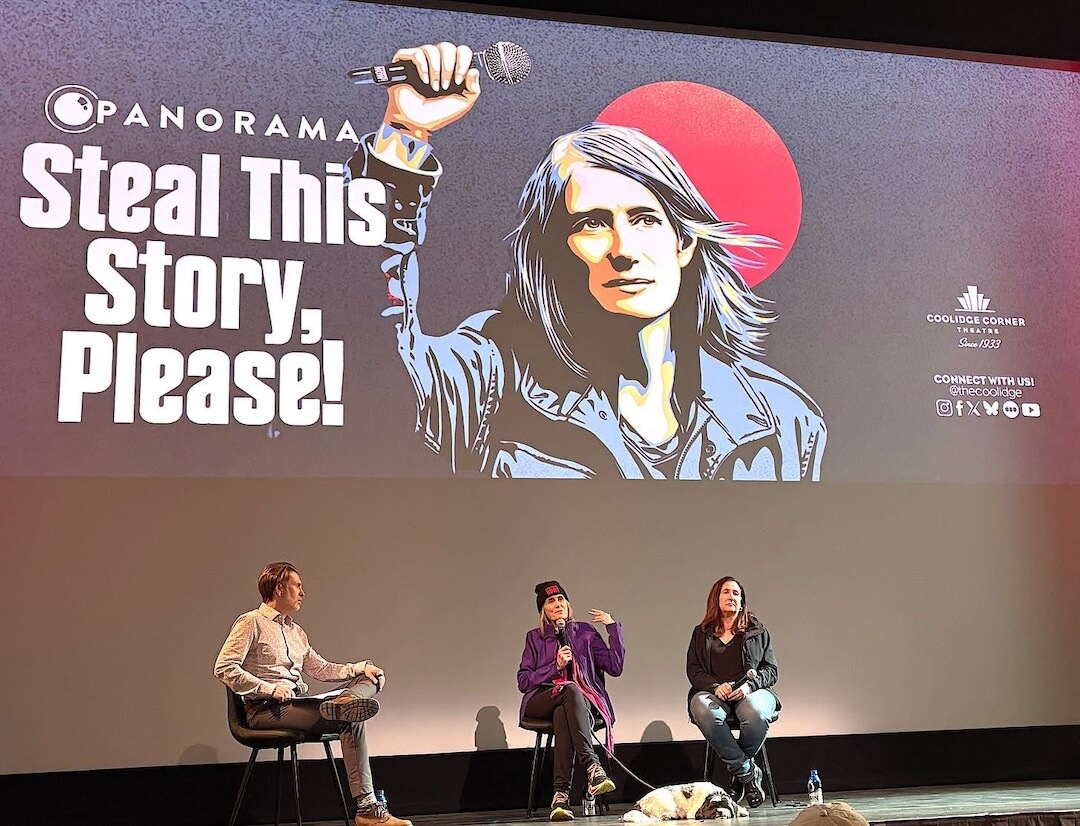
Amy Goodman (and her dog, Zazou) during a Q&A session following the showing of the new documentary about her and Democracy Now! at the Coolidge Corner Theater in Brookline, Massachusetts, April 30, 2026. (Bill Mitchell photo)
Goodman is an equal opportunity interrogator. In 2000, when then-President Bill Clinton was making media calls aimed at getting out the vote for Al Gore, he dialed up more than he bargained for when he called “Democracy Now!”
Goodman had some questions that were not on the president’s agenda, keeping him on the phone for 28 minutes. She pressed Clinton on NAFTA and on the record number of people — two million — behind bars during his presidency.
With irritation evident in his voice, Clinton said he needed to get off the phone. Goodman kept asking questions.
Just as important as Goodman’s irreverent approach to the powerful is her focus on what she describes as “the target end” of government: the people whose lives are affected by its policies.
The independently produced film highlights both dimensions of her work. It also spotlights the risks media consolidation poses to an informed public.
The film premiered at the DCDOX film festival last year and is currently making the rounds of local movie houses. I watched it at a sold-out event in Brookline, Massachusetts, that included a discussion with Goodman and director Tia Lessin.
Brookline is a close-in Boston suburb of 64,000 mostly well-off liberals (Trump managed only 12% of the 2024 vote there), so the turnout of several hundred for Goodman and the film was no surprise.
But the lively audience engagement with Goodman suggested a personal connection with a newscaster that’s difficult to imagine for a network anchor these days.
On journalists’ relationships with the subjects they cover
The first audience question came from someone who identified himself as a journalist with a couple years of experience.
“I’ve noticed that people just accept that journalists are supposed to be a little apathetic and maybe you should be emotionally removed from your subject matter,” he told Goodman. “I get the sense that that is not how you operate.”
Goodman proceeded to explain how she operates.
“What drives the people at ‘Democracy Now!’ and the whole independent media movement is the belief that we should provide a forum for people to speak for themselves and (to show) the bravery of those people… It is our job to provide a forum to have a critical discussion, especially in times of war.”
Gesturing toward her brothers Dan and David, who were in the audience, Goodman recalled discussions around the dinner table as they were growing up.
“I see the media like a huge kitchen table … that stretches across the globe and that we all sit around and debate and discuss the most important issues of the day.”
All good. But I found myself wishing that Goodman had used the question as a prompt to discuss a dimension of independent media that goes beyond ownership: independence not only from corporate bosses but from one’s own political convictions.
As an occasional viewer, I find “Democracy Now!” far more fact-based than much of today’s partisan ecosystem. But especially in the years ahead, as the Democratic Party struggles to sort out the conflict between its establishment leadership and its more progressive upstarts, “Democracy Now!” will have a great opportunity to press both factions about their impact on the “target end” of their policies.
To its benefit, the documentary relies more on showing than telling. The film documents the show’s coverage of the war in Gaza with the voices of Palestinians not often highlighted in American mainstream media.
Goodman credits her Jewish upbringing for a foundation of intense curiosity and a resolve to keep asking questions until answers emerge. The documentary includes a brief but entertaining excerpt from an interview Goodman did with her then-106-year-old grandmother.
Listening to the ‘target end’ of the story
The morning after viewing the film, I tuned into the 8 a.m. webcast of “Democracy Now!” The show’s coverage of that week’s Supreme Court hearings on temporary protected status for Haitians and Syrians included an interview with one of the Haitian plaintiffs, Viles Dorsainvil, a pastor and community leader of the Haitian diaspora in Springfield, Ohio.
Those are the people that Trump maligned by claiming — without evidence — that they were eating the dogs and cats of their neighbors.
Noting that Springfield officials and residents alike dismissed Trump’s claims as untrue, Dorsainvil described them as “folks in the community who … stand in solidarity with us because they know that, first thing, we are people with ethics and morals and that all we’ve been looking for is a safe haven and a place to work and to continue to send our kids to school.”
He added, “But we’ve been the victims of a leader that should normally focus on protecting a vulnerable group of people … but ended up putting some types of labels on people in the community.”
Interviewed on MS NOW on World Press Freedom Day last week, Goodman summed up her mission:
“What we do mostly is bring out the voices of people at the grassroots who are closest to the story,” she said. “Not your typical pundits who know so little about so much explaining the world to us and getting it so wrong, but the people who are affected most.”