
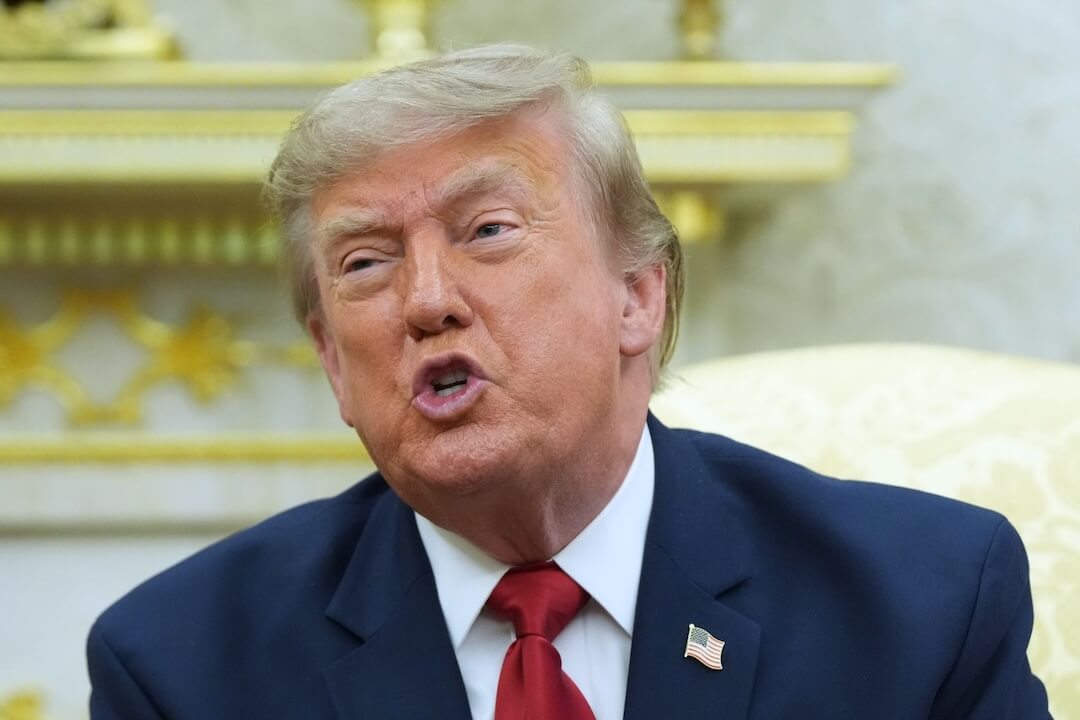
Presidential addresses to the nation are usually reserved for major issues — war, national emergencies or significant policy changes on critical topics such as healthcare or the economy. In other words, information that’s absolutely critical for the American people to know.
So when President Donald Trump announced earlier this week that he would address the nation in prime time on Thursday night, most assumed the topic would be the war in Iran.
But then MS NOW and others started to report that Trump’s address would not focus on the war, but instead on his issues with the 2020 election.
If that’s true, news organizations face a difficult question: Should they air it live?
On Tuesday, Trump seemed to confirm those reports. When asked if the speech would center on “election machines and election integrity,” Trump gave this answer:
“It will concern that subject and a couple of other things. I’d rather save it, but it’s really big news. It’s really, really big news. Our country has to shape up. But that’s what we’re going to be talking about Thursday, it doesn’t get bigger. Without free and fair elections you don’t have a country. We’ll be discussing other things too, but it’s going to be a very big announcement.”
Trump hasn’t detailed the speech publicly, but The Washington Post reported, “The president could use the address to press his long-standing allegations of foreign interference in the 2020 election, the results of which he has never accepted. The speech, in part, will highlight claims that China accessed U.S. voter data, said the people, who spoke on the condition of anonymity to discuss a plan that has not been made public. Trump is also expected to discuss findings related to Venezuela, they said.”
White House press secretary Karoline Leavitt said, “Anonymous sources are speculating about what President Trump will say during his speech on Thursday evening. The truth is, nobody knows yet what President Trump will ultimately say, which is why everyone should tune in.”
The question is whether viewers will be able to tune in at all. I reached out to the major TV and cable news networks (ABC, CBS, NBC, CNN, Fox News and MS NOW) to see if they planned to air the address. Not all answered the question, but of those who did, it appears that, as of Tuesday evening, none have made decisions on whether they will televise the address.
The Post wrote, “It was not clear Tuesday whether the major broadcast networks would provide airtime for the speech. As of late morning Tuesday, the White House had not requested for air time.”
Here are the bigger questions: Should networks turn over airtime for Trump to push unproven claims of a rigged election from six years ago? Should they give him free rein on the air to continue peddling misinformation about election results that he has never accepted?
And therein lies the issue with Trump that media outlets have been dealing with for more than 10 years. Frankly, it’s an issue that media outlets haven’t been able to figure out.
On one hand, he’s the president. What he says is news. On the other hand, if he is going to make baseless accusations, don’t news outlets have a responsibility to ensure viewers aren’t exposed to lies and baseless conspiracy theories?
The New York Times’ Maggie Haberman and Julian E. Barnes wrote, “In recent months, the president has reiterated false claims that mail ballots are broadly insecure and that voting by noncitizens is widespread, as well as the baseless assertion that the 2020 election was rigged, despite the fact that no evidence of widespread fraud has been found.”
The news about the news, delivered every weekday
Join tens of thousands of journalists, media leaders and news enthusiasts who rely on The Poynter Report to stay ahead of the stories shaping the industry.
The Post reports Trump “will use findings from reexamined government files to argue that the country’s election infrastructure has vulnerabilities.”
The Post’s Isaac Arnsdorf, Perry Stein, Patrick Marley and Ellen Nakashima added, “Trump is making the prime-time announcement at the urging of advisers including Bill Pulte, the acting director of national intelligence, and John Solomon, a former conservative journalist who temporarily joined the White House to help review government records for release. Solomon has long questioned investigations surrounding Trump and has pushed for the release of FBI investigatory files related to alleged election interference.”
To be clear, the Post added, “Since Trump returned to office, multiple federal agencies have pursued allegations of tampering with the 2020 vote that had previously been investigated and rejected.”
The networks have several choices:
- Carry the address live in its entirety and then follow up by fact-checking and contextualizing Trump’s comments.
- Carry the address live but cut away if Trump starts saying things that are untrue, explaining why.
- Decline to air the speech at all, and instead follow up with reporting, including fact checks and highlights, of what Trump said.
The third option seems the most prudent, especially when you consider that Trump’s most recent national address — about Iran in April — really didn’t say anything new. Networks also don’t want to continue handing over time to Trump just so he can air grievances. If what he says ends up having a true and real news value, follow-up reporting can cover that. There’s also a chance Trump will talk about Iran, as well, and that information could be useful to Americans. There’s also a chance he could announce some shocking idea on how elections should be conducted, and that is something that citizens will need to know.
Again, reporting on that after his speech might be the wisest approach.
Then again, the argument could be made that by editing out or completely censoring Trump’s often-outlandish commentary and wild claims, and sticking to just the factual parts, networks are normalizing Trump and making him seem sensible and responsible.
Under normal circumstances, turning over the airwaves to the president to address the nation would be a no-brainer.
But Trump and his addresses are not normal, and so networks continue to struggle with the best way to cover him.
New York Democratic Rep. Alexandria Ocasio-Cortez, for one, thinks the networks should not air the address, telling MeidasTouch reporter Pablo Manríquez, “I think we have an ethical obligation not to air things that undermine our elections and are not rooted in fact.”
A picture worth 1,000 conspiracies
After a month of speculation about his health, Kentucky Republican Sen. Mitch McConnell released a photo Sunday in an attempt to prove that he was alive and on the road to recovery.
But, of course, now that photo is being dissected. In a world with conspiracy theories and artificial intelligence, that should come as no surprise.
In the photo, McConnell is sitting in a chair, wearing a red-and-white checkered button-down shirt and blue jeans. His wife, Elaine Chao, is sitting next to him with her right hand behind McConnell’s left arm. McConnell’s right arm is holding Sunday’s sports section of The Washington Post.
This was supposed to be proof of life, so to speak. To which many joked that the surprise wasn’t that McConnell was still alive, but the Post’s sports section was still alive. (The Post cut the sports section during massive cuts in February, but has since hired some journalists to cover sports again.)
So what about that photo? Is it real? Is it current? Was it doctored by AI? And, conjuring up memories from old hostage photos and videos, was the placement of that day’s Post sports section purposeful?
The Post’s Ben Binday reported that the day after the photo was released, “The Post reviewed a copy of the original photo — provided by McConnell’s office at The Post’s request — and found that its metadata appears to show it was taken Sunday.”
Then Binday added, “An independent digital forensics expert also said there appeared to be no evidence that the image is fake.”
PolitiFact staff writer Caleb McCullough also examined the claims in “The internet says Mitch McConnell’s hospital photo is fake. The evidence says otherwise.”
McCullough talked to multiple digital and/or multimedia forensic experts who found no evidence of AI generation.
McCullough added, “We also checked the images against image verification tools from OpenAI and Google, which can check for markers that the image was generated using ChatGPT or Gemini. Neither detected signals associated with those generation tools.”
Until McConnell is physically seen speaking or appearing in person, speculation about his health will likely continue. But, by all accounts, it does appear that the photo released Sunday is legitimate.
Remembering a legend
Prize-winning cartoonist Pat Oliphant, often called the dean of political cartoonists, has died. He was 90.
The New York Times’ Robert D. McFadden wrote that Oliphant “drew and sometimes eviscerated a rogues’ gallery of presidents, pedophile priests, warmongers and other editorial-page villains for American newspaper and online readers for half a century.”
In 1967, the Australian-born Oliphant won a Pulitzer Prize for Editorial Cartooning while working at The Denver Post. For many journalists, winning a Pulitzer would be a career highlight. For Oliphant, it turned out to be a source of irritation. He had submitted 12 cartoons to be judged. The Washington Post’s Alec Dent noted that Oliphant was proud of 11 of them and didn’t particularly like the other one, but knew might it play to the jury’s politics.
Dent wrote, “He won the prize — for the one cartoon he didn’t like, an image of North Vietnamese leader Ho Chi Minh holding a dead body, captioned, ‘They won’t get us to the conference table … will they?’ Mr. Oliphant was enraged. For years afterward, he condemned the Pulitzers, never again submitting his work for a prize that was awarded, in his view, more on the basis of politics than skill. ‘It’s a fraudulent award,’ he said.”
He had a fabulous career. In 1990, The New York Times Magazine called him “the most influential editorial cartoonist now working.” But he was also heavily criticized by some who found that his work crossed the line.
Check out McFadden’s and Dent’s remembrances for more on Oliphant’s career.
Media tidbits
- Mediaite’s David Gilmour with “‘He’s Admitting it!’ Dan Abrams Warns Trump Is ‘Trying to Cheat’ in the Midterms.”
- The New York Times’ Ed Shanahan and Jonah E. Bromwich with “E. Jean Carroll Receives $5.6 Million Payment From Trump in Civil Case.”
- The Atlantic’s David A. Graham with “Does Todd Blanche Have a Red Line?”
- Page Six Hollywood’s Ian Mohr with “Controversial Vice founder Shane Smith shopping explosive tell-all about wild-child life, rise and fall of $6B company.”
- For Poynter, Mark Simon with “This baseball newsletter is proving that smaller audiences are good business.”
- If you’ve been watching the World Cup, you’ve noticed that each match has two hydration breaks that last three minutes. That’s enough time for networks to slide in commercials. Last month, The Hollywood Reporter’s Steven Zeitchik and Alex Weprin reported that Fox, which is airing the games in the U.S., will make at least $250 million in extra ad money. ESPN’s Ben Strauss follows up with “Why World Cup hydration breaks have media ‘salivating.’”
Hot type
- The Atlantic’s Alan Taylor with “Winners of the International Aerial Photographer of the Year.”
- NOTUS’s Ellie Silverman with “The Woman in the Photo Wanted to Be Alone. Instead, She Went Viral.”
More resources for journalists
- Start reporting today on the changes shaping the 2030 Census. Our Beat Academy course covers policy, methodology and local story opportunities. Enroll now.
- Join our first Leading AI in the Newsroom course, beginning with an in-person workshop in Los Angeles. Learn to build trust, drive adoption and lead AI initiatives while upholding journalistic values. Apply now.
- Learn how to report on the impact of incarceration on children, parents, guardians, and communities. Enroll now.
Have feedback or a tip? Email Poynter senior media writer Tom Jones at tjones@poynter.org.
The Poynter Report is your daily dive into the world of media, packed with the latest news and insights. Get it delivered to your inbox Monday through Friday by signing up here. And don’t forget to tune into our biweekly podcast for even more.
Considering the fact that these same national networks refused to air President Biden’s nighttime address to the nation on “The Future of Democracy” during the lead up to the Midterms in September of 2022 as they collectively felt it would be “too overtly political and partisan” (deciding to air reruns of ‘Young Sheldon’ & ‘Law and Order’ in its stead), this should be a non-starter.
I’m inclined to agree with Peter Baker who said during an interview on MSNOW Thursday morning just 12 hours prior to Trump’s mendacious self-promoting Oval Office address was scheduled to air:
“Oval Office addresses to the nation traditionally are on matters of great national importance that are not political; they don’t usually have a political sheen They’re (at) times of war, there are major disasters, there are major challenges to the nation when there is some overarching concern that has people at home worried & the president is trying to find ways of addressing their concerns, after riots, the BP oil spill in the Gulf of Mexico; that kind of thing. They don’t usually concern things that are so overtly political, so overtly partisan. That’s one of the reasons why the networks didn’t take President Biden’s nighttime, prime time address to the nation; they decided not to take it live because they felt it was too political. That’s the choice they have tonight: do they take something that seems to be about advancing the president’s political interests & the (false) narrative he’s been trying to sell the people on about the credibility of elections, particularly election he loses.”
The hypocrisy of what appears to be the three major network’s impending acquiescence to Trump’s demands to have his speech preemptively televised (& the corresponding threats of thoroughly compromised FCC Chair Brendan Carr) notwithstanding, there is a prospective advantage to having this speech televised nationally across the board as doing so will allow the otherwise peripherally-engaged American electorate to watch Donald Trump make a complete fool of himself spouting ludicrous & exhaustively debunked crackpot conspiracy theories while publicly obsessing over an election he lost by a record plurality of 7.125 million votes 6 years ago that he still petulantly refuses to concede.
Of course, the claims about the 2020 election will be false. But as there’s a potential danger of an executive order with serious consequences being explained by the address, not airing it live would delay the warning Americans would recieve of what is about to happen. So I can’t agree with declining to air the address.