This article is part of The Poynter 50, a series reflecting on 50 moments and people that shaped journalism over the past half-century — and continue to influence its future. As Poynter celebrates its 50th anniversary, we examine how the media landscape has evolved and what it means for the next era of news.
Politics has changed a lot in 50 years. So has political reporting.
In the 1970s, the quintessential political reporter was David Broder of The Washington Post. Broder, who died in 2011, was known for his deep network of sources in state and county political organizations, and even more so for his penchant for “shoe-leather” reporting — a willingness to trudge through far-flung neighborhoods to ask voters what mattered to them when deciding how to cast their vote.
Broder’s competitors — The New York Times’ R.W. “Johnny” Apple, and Jack Germond and Jules Witcover of The Baltimore Sun and The Washington Star — were also known for being shoe-leather reporters, and for their access to key figures inside presidential campaigns.
But since the days of “The Boys on the Bus” — and, yes, for a long historical moment, political reporters were mostly “boys” — political journalism has been shaped by a series of revolutions.
First came the emergence of professional political handicappers, notably Charlie Cook and Stu Rothenberg, in the mid- to late 1980s. They scoured the candidates and electoral patterns in hundreds of congressional districts, helping journalists narrow down which races were worth watching. Now, their safe-likely-lean-tossup assessments are so ubiquitous that they’ve become a no-longer-noticed part of the fabric of political journalism.
In the 1990s came the internet, which enabled reporters to easily access data, helping make political reporting less dependent on inside access to candidates and campaign staff and more attentive to the structural forces — electoral, demographic and economic — that were shaping voter behavior.
Finally, in the first two decades of the 21st century came quantitative analysts like Nate Silver, whose blog-turned-website FiveThirtyEight aggregated polls and ran statistical models to determine the probability of a given candidate winning.
Thanks to Silver and his successors, on-the-ground access to candidates and campaign professionals is no longer required to practice political journalism. All that’s needed is a computer and an understanding of statistics.
“I don’t think the current generation views shoe-leather reporting as valuable — they question its value, calling it ‘anecdata,’” said Ron Brownstein, who covered presidential politics for the Los Angeles Times beginning in the late 1980s. “They trust and emphasize quantitative data.”
Brownstein said the new era is so different from the old days that “they don’t even call pols ‘pols’ any more.”
***
For younger reporters in the era of Broder & Co., “the rest of us mimicked them,” recalled John Harwood, who cut his teeth on the presidential campaign trail in 1988 with the St. Petersburg Times and later worked for The Wall Street Journal, The New York Times and other outlets.
Brownstein said political journalism back then was more of a storyteller’s art. He recalled seeing novelists Joan Didion and Jimmy Breslin on the campaign trail early in his career. “There was a sense of the presidential campaign telling something bigger about the nature of the country,” he said.
The shift from the inside game to the outside game evolved gradually.
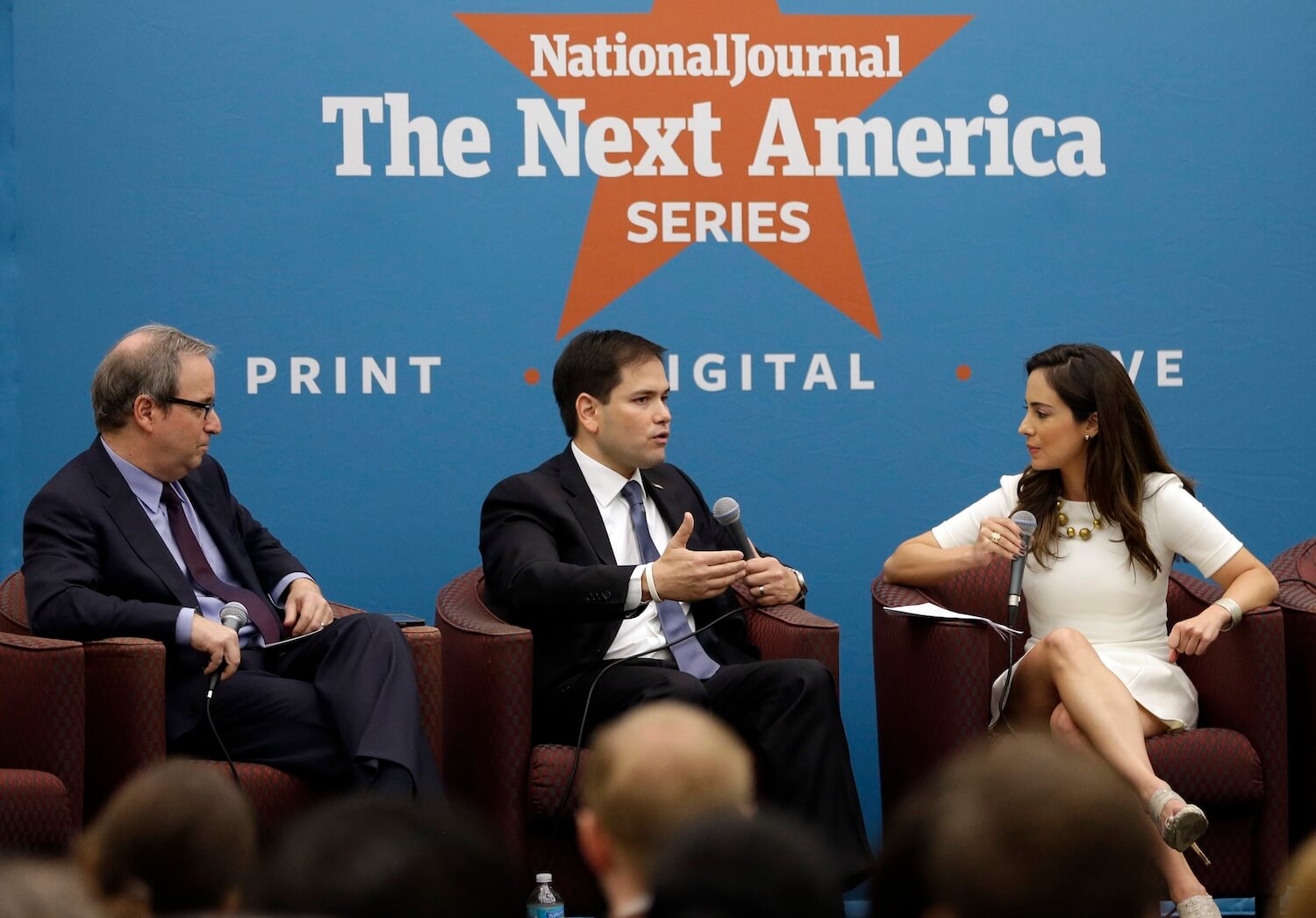
Sen. Marco Rubio, center, responds to questions posed by Ron Brownstein and Mariana Atencio of Fusion, right, on Feb. 10, 2014. (AP Photo/Lynne Sladky)
Early on in political reporting, “you were pretty much assured a good deal of in-person access to candidates and staff,” said Adam Nagourney, who has covered presidential elections since 1988 and who, since 1996, has been with The New York Times. “You could get on a plane, or a bus, for the purpose of trying to track down senior campaign aides who were traveling with the candidate.”
Until recently, interviewing voters in restaurants, bars, coffee shops, and homes “was a staple of American political journalism,” said Ron Fournier, a former Associated Press journalist who got his start as a statehouse reporter in Arkansas covering then-Gov. Bill Clinton. “Journalists of the pre-social media era knew that the best way to understand American politics was to understand American voters, and how their lives and livelihoods were changing. I could learn more from talking to two dozen voters in Iowa than I could from reading 100 polls, because I could plumb deeper in an in-person conversation than a vendor could on a call.”
John King, a longtime political journalist for The Associated Press and CNN, recalled covering the Iowa caucuses in 1987, when he was 24, talking to voters at factory gates, shopping centers and neighborhoods. When he bumped into Broder in one of his outings, King thought to himself, “If I picked the same neighborhood as a legend, I must be in the right place.”
But the changing nature of politics has made such reporting less valuable — or at least less desirable — for a new generation of reporters.
For candidates, the risk of an offhand remark to a journalist going viral has led most to curtail their once-common face-to-face press availabilities. (A major, and notable, exception is President Donald Trump.) Meanwhile, many lawmakers understand, deep down, that their role is to be a vote for their party’s agenda, not an independent actor, Brownstein said.

CNN’s John King on Feb. 22, 2012. (AP Photo/Ross D. Franklin)
Voters have changed, too. In the old days, “the image of who you thought writing for was a civically minded, well-intentioned, thoughtful voter struggling with how to make up their mind,” Brownstein said. “Somewhere along the way — accelerated by cable news and the internet — that image shifted to a partisan who wants to know how well their team is doing.”
Today’s deep political polarization “has caused most voters to know how they will cast their ballots well in advance of a presidential election,” said Dan Balz, who recently retired as a political reporter from The Washington Post. “Figuring out those who remain undecided until the end — and who often do not vote — is a big challenge we all face.”
***
Much of the coverage during this early period “was not primarily analytical — it was what happened, and what happens next,” said Bill Schneider, who began covering presidential and midterm elections beginning in 1976, for such outlets as the Los Angeles Times, The Atlantic and CNN. A more analytical and explanatory approach began to develop in the 1990s — a shift, Schneider said, that has improved coverage.
A key turning point was the emergence of political handicapping. The genre was born far from the campaign-trail neighborhoods and union halls of Iowa and New Hampshire. It emerged mostly in Washington, among people who were not primarily journalists.
The idea originated with newsletters founded by two political professionals in the 1970s: Alan Baron, with his liberal-leaning Baron Report, and Kevin Phillips, with his conservative-leaning American Political Report.
The format jelled with the Cook Political Report, founded in 1984, and the Rothenberg Political Report a few years later. Cook had been a campaign strategist and had worked for a trade association and a polling firm; Rothenberg was an academic who found himself writing political analysis for conservative operative Paul Weyrich.
When Cook told Rothenberg he was thinking of starting an analytical newsletter, “I thought it was crazy,” Rothenberg recalled in a recent podcast. But then Phillips advised Rothenberg that he should view the newsletter as a loss leader, with the real money coming from things like speaking fees and paid research work. That proved to be a winning formula for both men in the decades since.
Cook and Rothenberg — who became good friends as well as competitors — collected off-the-record information from party campaign committees and pollsters, and they met with countless candidates seeking House and Senate seats every campaign cycle. They maintained a rigorous reputation for nonpartisanship and calling-it-as-they-saw-it. A joint interview with Cook and Rothenberg became a required stop for any candidate worth their salt.
The most durable innovation by Cook and Rothenberg was a continuum for race-by-race ratings. Cook’s included Solid Republican, Likely Republican, Lean Republican, Toss-Up, Lean Democratic, Likely Democratic, and Solid Democratic; Rothenberg added a “tilt” column on either side of Toss-up. Cook also pioneered a metric called the Partisan Voting Index, or PVI, which shows how Republican- or Democratic-leaning a state or district is. Cook and Rothenberg would be joined in 2002 by Sabato’s Crystal Ball at the University of Virginia Center for Politics. Together, they remain the “big three” of political handicapping.

Larry Sabato on April 2, 2014. (AP Photo/The Daily Progress, Andrew Shurtleff)
Suddenly, political journalists had a framework for political competition that drove how they allocated their reporting time and how they perceived the relative strength of the two parties.
In the pre-internet era, Cook recalls having to subscribe — at considerable expense — to out-of-state newspapers and clipping services, which allowed them “a sense of what most D.C.-based journalists were never seeing. The national political reporters of that era generally didn’t pay much attention to House and Senate races until the last couple of months before the election, so we could get a real head start on them.”
In time, their respective enterprises took off. Cook said he and Rothenberg benefited from fortuitous timing; as they were breaking through, newish cable networks like CNN and C-SPAN had “an insatiable appetite for political analysis, and there weren’t that many people doing it.” So they both became fixtures as commentators on national TV, helping define the parameters for the two parties’ electoral outlooks. Before he launched the Crystal Ball, Sabato was already a prominent on-air commentator.
Cook, Rothenberg and Sabato have survived into the era of quantitative outlets like FiveThirtyEight by factoring in the intangibles that poll-driven analysis simply can’t capture.
“Human beings are still human beings — they’re quirky and weird and do unpredictable things,” said Amy Walter, who succeeded Cook at the helm of what is now called The Cook Political Report with Amy Walter. “Some candidates look good on paper but aren’t, and vice versa. The candidate still matters, especially in campaigns decided by a few thousand votes. Those are things that no algorithm will tell you,” but which candidate visits and off-the-record hints from party officials can.
To this day, the handicapping these outfits publish remains crucial for political reporters at more conventional media outlets, Balz said.
“They point to the races that are most likely to be close, and therefore decisive, in the ultimate makeup of Congress,” Balz said. “We all have limited time and resources. Having something of a roadmap of where to go when is valuable.”
***
The emergence of the internet in the 1990s gave reporters instant access to data — not just voting history by jurisdiction and publicly released poll results, but also campaign finance filings and demographic and economic data.
“Some of the best tools existed 20 or 30 years ago, but they weren’t as easily accessible,” King said. “Now you can get almost endless data and use spreadsheets” to analyze it. “The speed with which you can find and collect data is amazing, and it allows for smarter, more historical and contextual political reporting.”
The apotheosis of the quantitative strand of political journalism came when Silver founded FiveThirtyEight.
This ease of access has helped democratize political analysis. Silver did not become a major player through the traditional route of walking urban wards and suburbs as a reporter; he worked variously in consulting, baseball analytics and even professional poker.
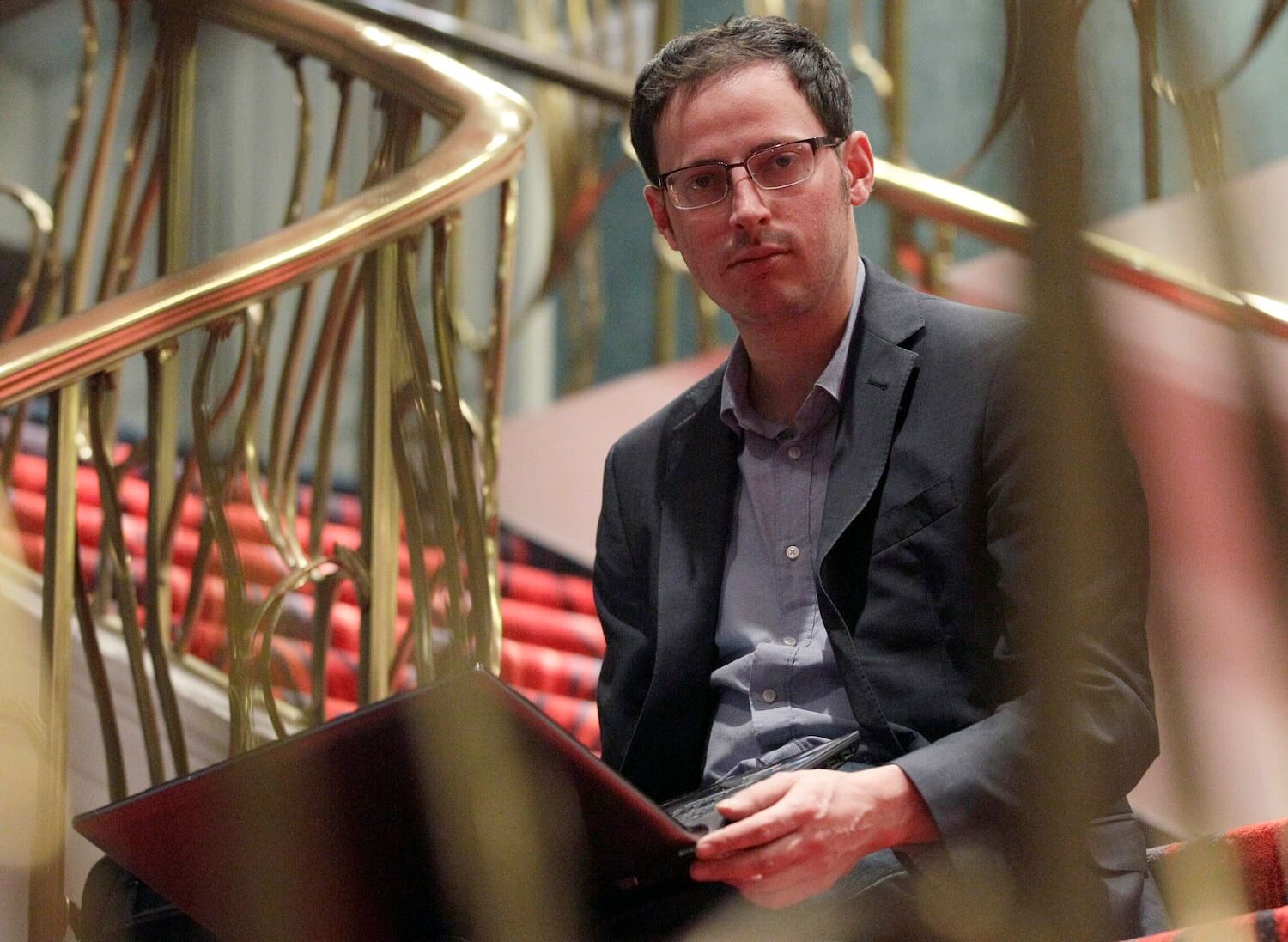
Nate Silver on Friday, Nov. 9, 2012. (AP Photo/Nam Y. Huh)
In 2008, Silver launched FiveThirtyEight as a pseudonymous blog. In time, and with the support of legacy media patrons like The New York Times and ABC News, Silver’s writing helped familiarize political junkies with such concepts as polling aggregation, election modeling, win probabilities and other types of statistical analysis — a methodological leap beyond what the reporting-based big three handicappers provided, to say nothing of the shoe-leather generation.
“FiveThirtyEight mainstreamed political analysis,” said Nathan Gonzales, who succeeded Rothenberg at his publication, which is now called Inside Elections. “FiveThirtyEight provided political analysis to a much broader audience.”
Nathaniel Rakich, an analyst at FiveThirtyEight until Disney and ABC shuttered it earlier this year, said the site forced pundits to do more than offer wisdom “based on vibes and gut instincts — things that ‘felt right’ to people, even when more rigorous analysis showed that they weren’t. Now, there’s an expectation that pundits provide evidence for any assertions they make.”
FiveThirtyEight and its quantitative peers, such as Nate Cohn of The New York Times, sought to educate rank-and-file readers about the limitations of polling — including the importance of margins of error, “house effects” that bias certain pollsters’ findings, and the need to look at outlier results in polling skeptically.
Since the advent of FiveThirtyEight, “there’s been a greater numeracy among journalists and news readers, a greater respect for polling, and a deeper understanding of how polls tell a story,” said Kaleigh Rogers, a reporter who spent four years with FiveThirtyEight.
This is not to say the quantitative approach has made either shoe-leather reporting or old-school handicapping obsolete. Just because a candidate has a better-than-average probability of winning according to a statistical model does not mean they are guaranteed to win. Just ask Hillary Clinton.
“We have a lot more tools now, but too many political reporters, I fear, let those tools replace getting up close to the people and the places instead of using the new tools to complement the ‘old-fashioned’ way,” said King, who became famous for his work with CNN’s data-heavy “Magic Wall” but who is now pursuing a more shoe-leather-oriented project called “All Over The Map with John King.”
Meanwhile, some polls are never made public, meaning that poll aggregators are unable to include them; handicappers, however, might. And if a poll result is within the margin of error, that doesn’t help if a race is decided by a point, as is often the case in the most competitive races. That’s a situation where an intangible factor could become decisive.
J. Miles Coleman, the associate editor of Sabato’s Crystal Ball, recalled making the opposite “calls” from what the pre-election polling showed in Georgia and Florida for the 2020 presidential race. Both of the publication’s calls were proven correct.
“Going only by polls, you may not have picked our split of Biden in Georgia and Trump in Florida,” Coleman said. “But we saw the Atlanta area getting bluer each cycle and thought it could finally put the Democrats over the top. Meanwhile, cycle after cycle, we’d watch Democrats lead in Florida polls, only to fail to close the deal.”
Several journalists expressed concern that today’s political journalists risk becoming too reliant on polling. A rising share of polling firms have lower-quality methodologies and “house effects” that push them consistently in one partisan direction or another, said G. Elliott Morris, who headed FiveThirtyEight at the time it was shuttered and who now publishes a Substack. Overreliance on such polls makes political analysis “very precarious,” he said.
Ultimately, each succeeding generation of political reporting has added a new layer of complexity and nuance to the journalism.
“We obviously have more data than we did 25 or 30 years ago,” Balz said. “Whether that has improved the coverage of politics is an open question. There are many more polls. We are drowning in them. Lots of data can be helpful, but the proliferation of polls has not directly led to a greater understanding of politics.”
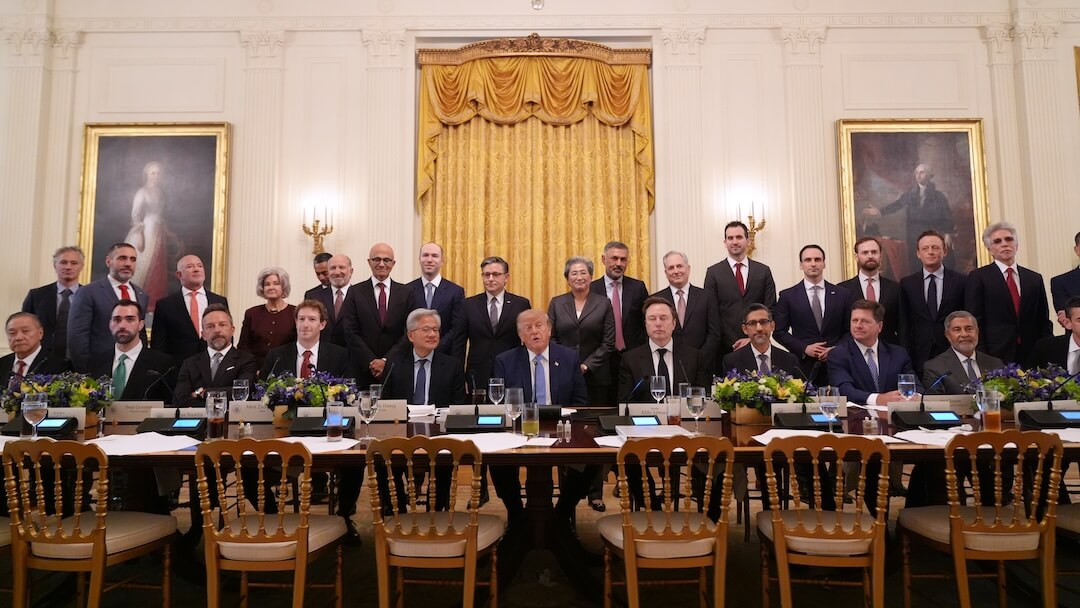
Here’s the complete identification of those pictured in the photo at the top of this article.
Standing, left to right: Dante Chinni (Wall Street Journal); John Reiss (Meet the Press); Rich Cohen (Almanac of American Politics); Kirk Bado (Hotline and Almanac of American Politics); Erin Covey (Cook Political Report); Nathan Gonzales (Rothenberg Political Report/Inside Elections); Ally Mutnick (Politico and Almanac of American Politics); Jacob Rubashkin (Inside Elections); Alex Roarty (McClatchy and NOTUS).
Seated, further back, left to right: Alexi McCammond (Axios); Peter Jones (Cook Political Report); David Wasserman (Cook Political Report); Charlie Cook (Cook Political Report); Amy Walter (Cook Political Report); Matthew Klein (Cook Political Report); Ally Flinn (Cook Political Report); Steve Shepard (Hotline, Politico, Pew Research Center).
Front row, seated, left to right: Kathryn Hamm (Cook Political Report); Josh Kraushaar (Hotline); Sarah Longwell (political strategist); Louis Jacobson (Almanac of American Politics).
(Credit: Ralph Alswang/Cook Political Report)
Louis Jacobson is chief correspondent for PolitiFact and chief author of the Almanac of American Politics. He is the only person to have been a regular contributor for the Cook Political Report, the Rothenberg Political Report, and Sabato’s Crystal Ball.